ITS OTR Board
A workflow redesign that simplifies shipment management for a fast-paced third-party logistics operation.
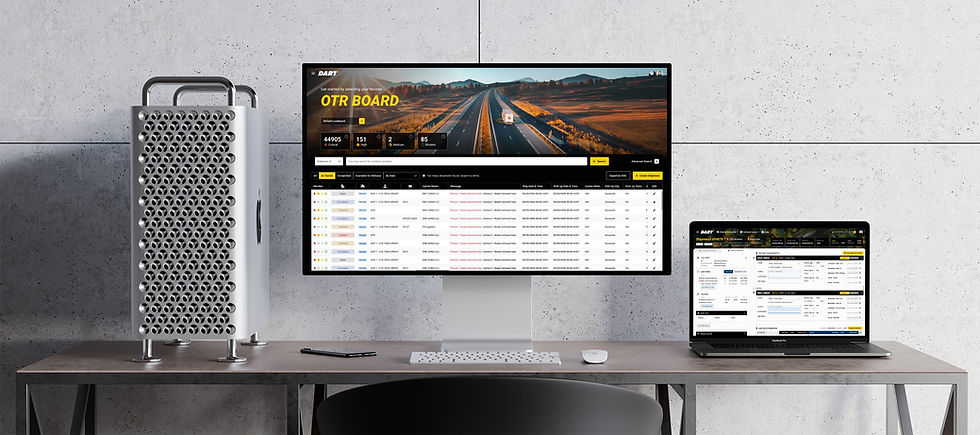
ITS OTR Board is an internal operations platform used by dispatchers to create shipments, assign carriers, and manage freight from warehouse to customer.
As a third-party logistics (3PL) provider, operational efficiency directly impacts profitability. Every shipment requires dispatchers to coordinate large amounts of information while making quick decisions under time pressure.
This redesign focused on simplifying complex workflows, improving information visibility, and helping dispatchers complete everyday tasks with greater speed and confidence.

My Role
Leading the end-to-end UX redesign of a business-critical operations tool.
I partnered with users and stakeholders to understand existing workflows, uncover pain points, and redesign the experience from research through validation.
My responsibilities included:
-
User interviews and workflow discovery
-
Persona development and journey mapping
-
UX strategy and information architecture
-
Wireframing and interaction design
-
High-fidelity UI design
-
Interactive prototyping
-
Usability testing and design validation
The Challenge
The challenge wasn’t simply modernizing the UI, it was helping dispatchers make faster decisions with greater confidence.
Managing shipments requires dispatchers to process large amounts of information while making fast, accurate decisions.
The existing OTR Board made this difficult by creating unnecessary complexity and slowing down common tasks.
Key challenges included:
-
Complex workflows that required too many manual steps
-
High cognitive load when managing multiple shipments
-
Poor visual hierarchy, making critical information difficult to find
-
An outdated interface that slowed everyday operations
The Approach
Rather than redesigning screens individually, I focused on understanding how dispatchers actually worked throughout the day.
Through user interviews and workflow analysis, I identified opportunities to simplify repetitive tasks and improve information visibility.
The redesign focused on three key principles:
-
Simplify workflows: Reduce unnecessary clicks and streamline common tasks.
-
Surface critical information: Improve hierarchy so dispatchers can quickly identify priorities and take action.
-
Design for speed: Create an interface that supports rapid decision-making without overwhelming users.
The Solution
The redesigned OTR Board transforms a complex operational system into a more intuitive workspace.
Key improvements included:
-
Streamlined shipment management workflows
-
Improved information hierarchy and readability
-
Clearer status indicators and task prioritization
-
More efficient navigation between related tasks
-
A modern visual design that reduces cognitive load during daily operations
The Impact
The redesigned OTR Board established a stronger foundation for future logistics operations by simplifying complex workflows and improving the overall user experience.
The project helped:
-
Reduce friction across core dispatch workflows
-
Improve visibility of critical shipment information
-
Create a cleaner, more intuitive interface for daily operations
-
Validate design decisions through user testing before implementation
Wireframes


Visual Design


